
Home / United States / Life on the Road, 2026
September 2026: Trying to manage everything. Actually managing nothing.
September did a good job of reminding me about the bad and ugly of VanLife. And my coping strategy has always been to manage the chaos: to-do lists, planning, preparing, anticipating. But I know that having control is not really in my control. “Trying to control things is like trying to catch the wind in a net” (Taoist proverb). But none of that occurred to me in the moment. I definitely tried to control as much as possible. (If you prefer not to hear about the nitty gritty, gross and dirty, scary and harrowing parts of VanLife, feel free to skip ahead. There are pictures at the end.)
Time Management
On September 1, I started teaching again, after an August sabbatical. To my delight, almost all my students have returned, and 3 new students have enrolled! So with each day, my teaching schedule has been busier.
But everything about living in a van takes longer. I estimate 3-4 extra hours per day to accomplish mundane tasks. PER. DAY. So if I’m working 4-5 hours a day and need an extra 3-4 hours just to conduct normal activities, I have very limited time for anything other than work and trying to live in a van. Calling friends? Writing this blog? Going on excursions and adventures? There is precious little time.
“An extra 3-4 hours a day?!” you may ask. Yes, and here’s why:
- PLANNING: This is such a time suck that I often just want to stay in one place for a week so I don’t have to plan again too soon. But it really doesn’t matter if I stay a week. The need to plan will hang over me. I worry that I’m missing something I should really see. I worry that I won’t get a parking or camping site because everything will be booked up. I have to consider (a) whether where I’m staying is optimal for solar power and Starlink; (b) if I can dump and fill my water, do laundry, or buy groceries (I’ve been in places where the only “grocery store” is the convenience store at the gas station); (c) what the weather will be like; (d) how much it will cost; (e) how long it will take to get there and the latest time for check-in; and (f) how all of that will fit with my teaching schedule. I have spent hours reading reviews, checking routes, trying to get satellite or street views of places and towns, comparing prices, researching activities. There are a lot of websites and apps and services that help, and ChatGPT has been a great addition to itinerary planning. But sometimes you just have to call or email ahead of time. And sometimes even after all of that, you get to a place and it’s gross, scary, or not really safe or legal to park. So you always have to have a backup plan. Always.
- DISHES: I don’t do them every day, actually, because (a) I hate doing dishes and (b) I need to monitor my water and power usage. So I have found a very functional way to “hide” my dirty dishes so I don’t have to look at them in my sink or spit toothpaste onto them. But even when I have water and power, I am very careful not to waste them. Have you ever measured how much water runs down the drain from rinsing soap off dishes? It’s a lot. But my water- and power-saving method of doing dishes is not a time-saving method! I use a water-filled spray bottle to dampen my sponge and the dish, scrub the dish, and then use the spray bottle to spray off as much soap as possible. Then I pour a small amount of boiling water over the dishes to get the last of the soap and germs. I do this in batches, and I typically have about 3 batches of dishes by the time I actually do them. I dry and store them (no room to let them drip dry), and then begins the clean up and drying of everything else: the dish rack, the drip cloths below the dish rack, the dish towel, all of which take time to dry in a small space, especially if it is humid or rainy, and there are just not that many hooks or surfaces to hang or dry things. It is such a small space that everything has gotten wet: the counter, the floor and bench where water has splashed, the apron I’m wearing. They must all be clean and dry because wherever I set them down is about to be used for some other purpose.
- CONVERTING THINGS TO THEIR OTHER PURPOSES: Everything in the van can be used for another purpose, sometimes 3 or 4 other purposes. The sink is for cooking, cleaning, brushing teeth, washing face, connecting the shower nozzle… everything I need running water for. The counter next to the sink, where I might set the dishes to dry, can be raised up on hinges to reveal the toilet (if nothing is resting on it). The toilet can be moved to convert that space into a shower. The bench on the other side of the sink conceals the refrigerator and is also the bench seat for my desk. This means I am CONSTANTLY moving things around to access, transform, hide, or reveal another use. The jacket and umbrella I tossed onto the bench have to move so I can access the fridge, but they can’t go on the couch because I am converting it to a bed, and they can’t go in the driver’s seat because that already has a bag of trash for which I haven’t yet found a dumpster, as well as the overflowing laundry bag, and both of those will have to move out of the driver’s seat tomorrow so that I can drive. But because they are awaiting their final resting place (a dumpster or a laundromat), they will have to go on the floor on driving days because there is nowhere else for them. And there are several items in that same category — that have a home on the floor on driving days — so that anytime I have to slam on the brakes while driving, they all loudly slide toward the driver’s seat, while I am already panicked because of whatever just caused me to slam on the brakes.
- TAKING A SHOWER: I’m sure it is not surprising that this can take some effort in a small space like a van. Many van-dwellers don’t have showers at all. But I absolutely hate using public showers and public bathrooms. I don’t like having to shower in flip flops, and I always forget something in the bag of supplies that I bring to the public shower (so I may have to wash my hair with body wash or wash my body with shampoo). I had a particularly traumatizing experience in a campground shower years ago, and I just knew I would want to have and use a shower in the van. And I definitely use it. I have privacy in the van compared to a public shower. I know it is cleaned after every use. I don’t panic if my towel touches the floor, like I would in the tiny stall of the nasty campground bathroom. Gross. I hate public showers. And although converting the space hidden below and behind some cabinets into a shower is time consuming, it is not the part that causes me the most stress. Most stressful is managing water and power. The electric hot water heater is the biggest power suck in the van. On the plus side, no matter when I heat the water, it will stay hot for several hours. But it takes planning. A shower also requires sufficient fresh water, as well as sufficient space in the gray water tank. I find myself planning for my next shower as soon as I’ve finished one. And I don’t take one every day. I hope for every other day, but I’ve definitely gone 3 days. But with all of that said, I still prefer it to using a public shower. Just… yuck.
Waste Management (skip if you are easily grossed out)
If you don’t stay in RV parks with “full hookups” (which can be very, very expensive and often have a certain … vibe), then your next “dump and fill” will take extra planning: dump the gray water and fill the fresh water. My gray water tank is completely separate from my toilet system. It is NOT a “black tank.” The Sierra Club says graywater has several legal uses, including for landscaping. One RV park owner told me to splash it on her flowers. I have occasionally used creative methods to dump my gray water. But mostly I use dump stations, and I’ve found them at many non-campground places: gas stations, wastewater treatment plants, truck stops…. But it’s just not pleasant to go to those places! Also yuck!
Then there is the toilet. I have what’s called a “composting toilet,” but the solids do not really “compost” — the solids compartment lacks the necessary time, heat, and biological conditions to actually compost. But it is filled with dry composting material, and as long as it stays dry, it doesn’t smell. I have a large compartment with a vent fan, so I typically swap out the used material with the clean composting material every 6 weeks. “Swapping out” is a very sanitized(!) expression for it, though. No matter how hard I try NOT to see inside the compartment, I know it is there. I see, out of the corner of my eye, more than I would like to see. And with this particular composting toilet, you can’t line the solids compartment with a bag. To empty it, you must take the toilet apart and cover the solids compartment with a large bag and then invert the toilet and shake everything out. So, obviously, it’s gross.
What the toilet should be called is a “urine-diverting toilet.” The solids compartment stays dry because urine is diverted to a bottle. The pee bottle requires much more frequent emptying, often every other day. 90% of the time I carry it to a restroom and pour it out. However, the plastic bottle is an odd shape and opaque (so that I can see how full it is), so I assume it will attract at least a double-take from a passerby. I have dedicated a reusable grocery bag for the purpose of disguising the bottle. But worst of all is that it does not have a lid (I finally ordered a lid, but thus far I have never capped off what is often a very full bottle). It’s just an overall gross and horrifying process. I’m in a state of panic the entire time in case I spill it or someone asks me what the hell I’m doing. Having given my potential answer some thought, I will tell the truth: “I am emptying a bottle of my own urine.” If that ever happens, I will report back on the response.
So that is how I empty it 90% of the time. That other 10% of the time? Hey, men pee outside all the time! So occasionally I pour it in the woods or on a bush or someplace where I can imagine a human male or any animal also depositing pee. I think that’s fair.
Mental Health Management
The mental fatigue from managing all of the above, plus working and driving, takes a huge toll. And doing it alone is its own kind of mental illness. September brought some low points for me, but to be honest, I’ve traveled alone so many times that I’m getting better at managing them. I forgive myself. I accept the difficult moments, scary situations, and crushing loneliness. I do wish I could find a travel companion, but I also fear I am set in my ways now.
One of the scariest moments on this trip was when Google Maps led me down a road — a term I use loosely for this mud-filled and pothole-riddled passage — that I followed for far too long, in the middle of nowhere in New Brunswick, in the rain, when I should have turned around much sooner. I have become so trusting of Google Maps on these journeys that I believed it when it showed me a right turn ahead that would get me out of there. It was raining steadily, and the road was becoming more and more dangerous, but I kept following it. At the bottom of a decline, the rain had pooled completely across the road into a pond. I stopped and tried to talk myself out of going through, but I really believed that civilization was right around the corner, and I knew that the road I had just traveled was in terrible condition, probably getting worse with the rain, so turning back seemed just as dangerous. So I went through it. The van survived, but the promised turn at the corner ahead was a grassy path, not a road! I was incredulous. I couldn’t decide whether I should cry or throw up. There were no buildings, no other cars, no sign of other people. Why didn’t I turn back? I don’t know, but I didn’t. I came to another pond. I went through it. Google Maps had been using kilometers ever since I’d crossed into Canada, so at that moment, I had a hard time visualizing which distance was worse — continuing forward or turning back. I came to a third pond, deeper and more rocky than the other two. I finally came to my senses and turned around. It was not easy to turn the van around on that road! After many mini back-and-forth movements, risking driving an extra foot past the road’s edge, hoping it was strong enough that the van wouldn’t sink, I finally turned around. I drove back where I had come, back through the two ponds, and through mud that was thicker than ever, somewhat following my own tire tracks, now filled with mud, and finally got back to the paved road.
I was truly traumatized. I finally cried. I called two people back home to steady me and remind me that the worst did not, in fact, happen. I felt absolutely terrified to drive on any unpaved road after that. My next stop, after leaving New Brunswick, was the Mount Katahdin National Monument in Maine that, it turns out, contains NO paved roads. Well, I did not visit it! That area of Maine is also along the “Golden Road,” a barely maintained private road built to transport lumber from Canada to a paper mill 96 miles away. It is a gravel road that, at the time of my visit, was in horrible condition. Google Maps led me onto that road as well! Two seconds later, I turned right around. Hell no!
Early in this trip, when I was driving 6+ hours across states that were hot or smoky in early August, I depended on what I dubbed “fetal position therapy” to calm my nerves. My couch in the back of the van is my happy place that I retreat to at the end of every day. And after driving days, I really needed a refuge. But the width of the couch is too small to stretch out (as a bed, it stretches to queen size, but the couch is the width, not the length, of the bed). So I can only lay down on the couch in the fetal position. And my portable air conditioner is only effective when pointing 65-degree air directly in my face. It does cool one’s core temperature, and it also filters and dehumidifies the air. So every day, after driving, I would curl up in the fetal position on my couch, point the air conditioner vent directly at my face, and decompress, reset, or simply rest. It became so therapeutic that even now I still promise myself some fetal position therapy after a long or stressful day, though I no longer need the air conditioner.
But the best therapy has been a 2-week trip home, having parked the van in Boston and gotten a nonstop to San Francisco. I saw friends in the Bay Area, and then headed home to the house Anna is still living in, even though most of its contents are in a storage unit and she is paying the full rent and utilities. So I write this from my old desk and old desk chair, enjoying an indoor sewage system and unlimited electricity.
And yet, I’m ready to get back on the road. I have plans to modify more things in the van to make my life easier (it is actually a lot easier than 4 years ago when I made my first cross-country trip). I will probably splurge on an AirBnB more often than I have been, to maintain my mental health a little better. But there is more to see. More to experience. More ways to center myself and be present with all these challenges. More ways to release the need to make things happen and simply notice what is already happening (I’m into Taoist proverbs at the moment).
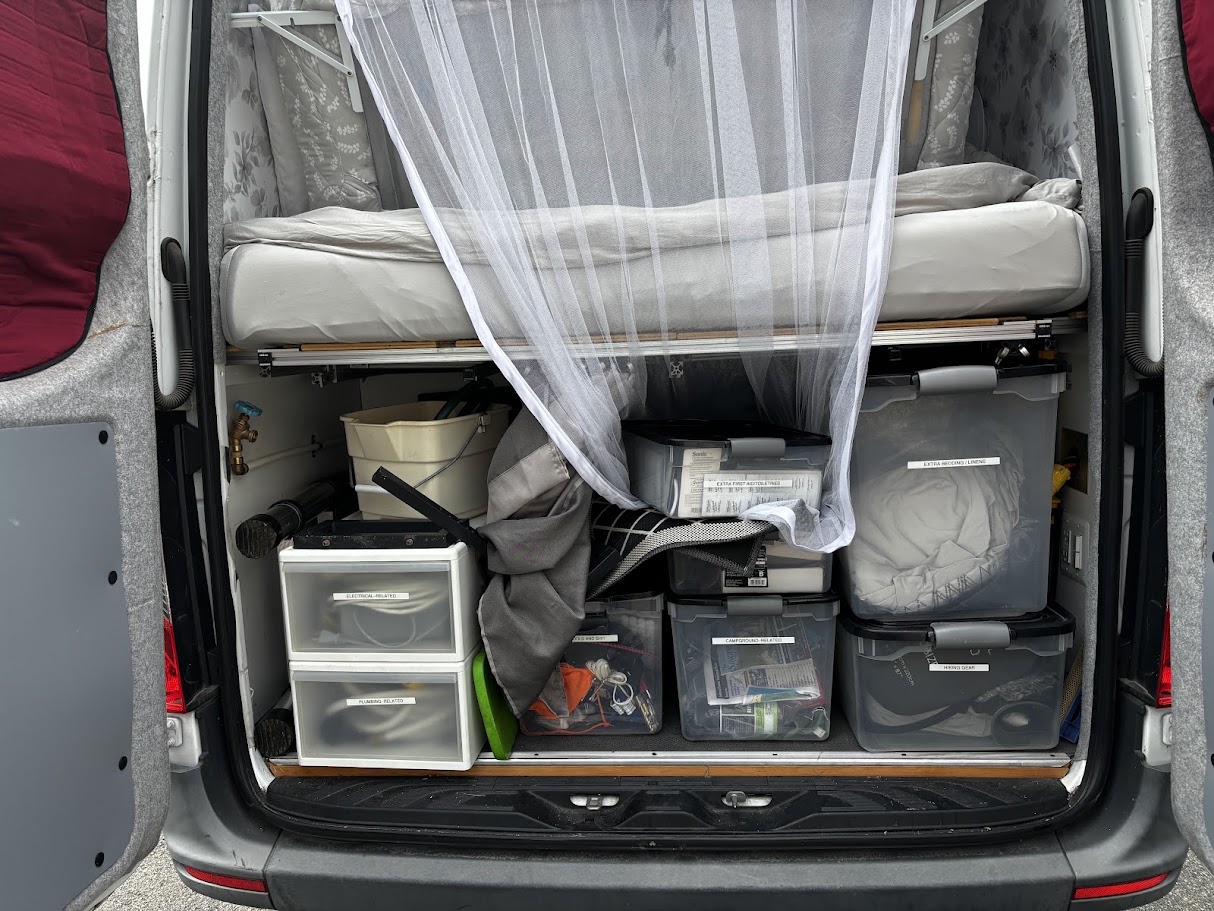
Here are some photos not of beautiful places I’ve parked or visited, but of the interior of the van and daily life in this tiny space (click to enlarge).
What living in a tiny house on wheels really looks like


NOTE: Please leave a comment, but a heads-up that comments are moderated to prevent spam. I will approve yours asap.